Understanding Behavioral Influence in Healthcare Settings

Doug Jorgensen
March 30, 2026
A growing body of discussion on X has drawn attention to how well-known psychological experiments may help explain patterns of behavior observed during the COVID-19 pandemic—particularly within healthcare systems and among medical professionals. These comparisons suggest that authority, social pressure, and institutional roles can significantly shape decision-making, even in environments expected to be grounded in independent scientific judgment.
The Milgram experiment, conducted in the 1960s, demonstrated how individuals may comply with authority figures even when actions conflict with personal judgment. Participants continued administering what they believed were harmful electric shocks simply because they were instructed to do so by an authority figure. The study has long been used to illustrate how perceived legitimacy and institutional backing can override individual reasoning.
The Asch conformity experiment further revealed the power of group consensus. Participants knowingly gave incorrect answers to simple questions when the rest of the group did the same, showing that social pressure alone can lead individuals to abandon their own observations in favor of alignment.
The Stanford prison experiment demonstrated how quickly behavior can shift when individuals are placed into roles within a structured system. Participants assigned positions of authority began exhibiting harmful behaviors within days, highlighting how institutional environments can influence actions beyond personal character.
Taken together, these experiments suggest that under sufficient pressure—authority, consensus, and institutional reinforcement—individuals may suppress independent judgment and conform to dominant narratives.
Many critics argue that these same dynamics were evident during the COVID-19 pandemic. They point to instances where medical professionals and public health officials appeared to align closely with centralized guidance, even as data surrounding morbidity, mortality, and natural immunity continued to evolve. In this view, open scientific debate was, at times, limited in favor of maintaining unified messaging.
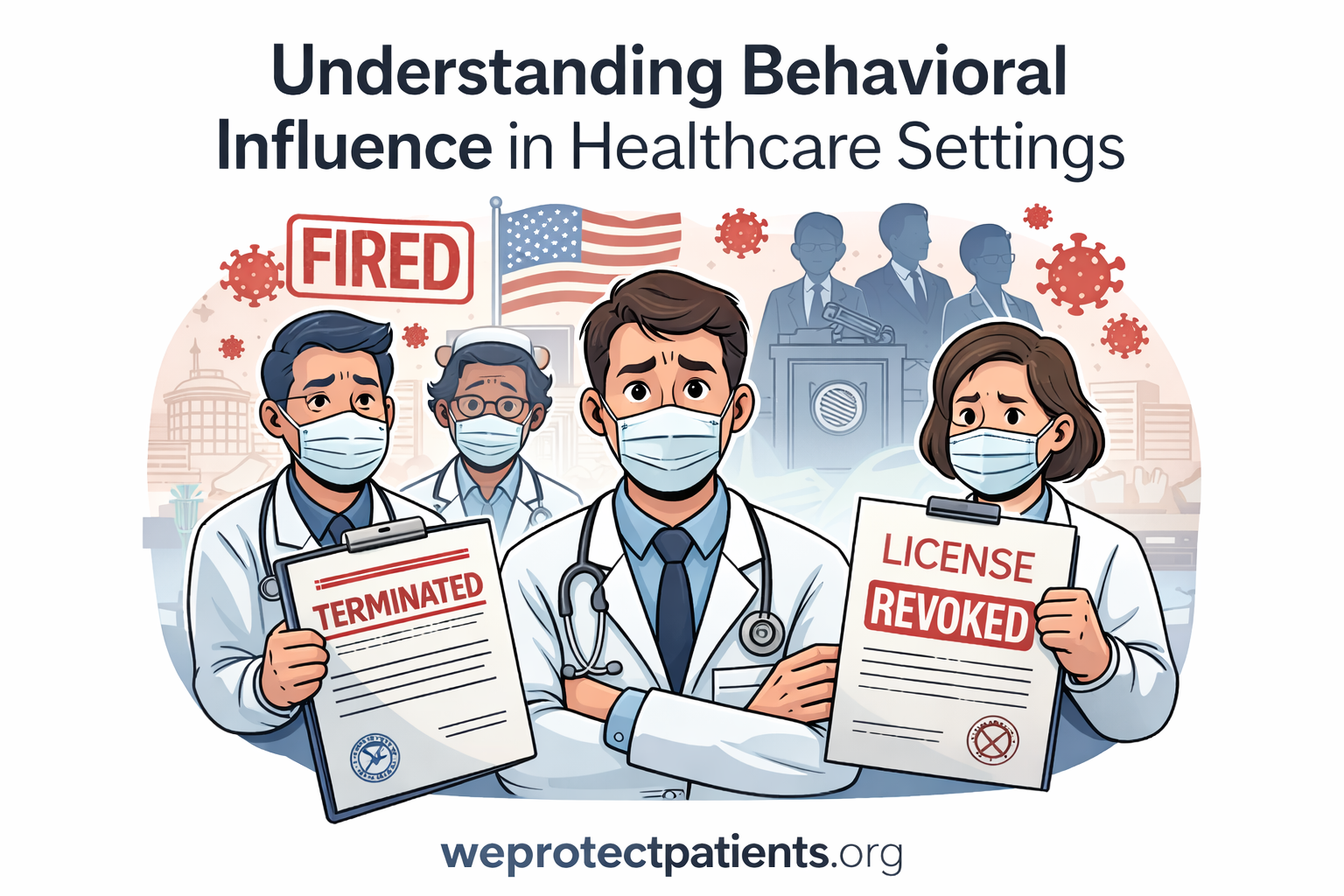
There have been widely reported cases in which physicians, researchers, and healthcare professionals faced professional consequences—including loss of positions, reputational damage, or disciplinary action—after expressing perspectives that differed from prevailing recommendations. Critics suggest that this environment reflected the same behavioral pressures identified in the Milgram, Asch, and Stanford experiments: compliance with authority, conformity to group consensus, and adherence to institutional roles.
At the same time, it is important to acknowledge that the pandemic presented unprecedented uncertainty and required rapid decision-making at a global scale. Public health responses were shaped by evolving data, risk management priorities, and the responsibility to protect large populations. As a result, interpretations of these events remain complex and, in many cases, deeply debated.
For patients, understanding these dynamics is critical. Healthcare decisions are not made in isolation—they exist within systems influenced by authority, consensus, and institutional structure. Awareness of these factors can empower individuals to ask questions, seek additional perspectives, and take a more active role in their care.
Ultimately, while psychological experiments cannot fully explain real-world events, they offer a valuable lens through which to examine how behavior can be shaped under pressure. Recognizing these patterns may help patients navigate healthcare decisions with greater clarity, confidence, and awareness.
This article references a discussion shared on X:
View original post here.
About the Author
Douglas J. Jorgensen, DO, CPC, FAAO, FACOFP
Dr. Doug is a national consultant in pain management compliance and a practicing physician. He trains providers to balance effective relief with proactive health monitoring for patients on long-term controlled medications.