The Case for a Simpler Healthcare System

Doug Jorgensen
March 3, 2025
Introduction: Complexity Is Not a Sign of Quality
In healthcare, we’ve built a system so complex that even seasoned professionals struggle to navigate it. Patients feel lost, providers feel buried, and the only ones who seem to benefit are those who profit from the complexity itself.
The irony? Simpler systems aren’t just easier—they’re often more efficient, more cost-effective, and better for patient outcomes.
How We Got Here
Over the decades, layers of regulation, insurer requirements, and billing codes have turned straightforward care into an obstacle course.
- Billing and Coding Expansion – Thousands of CPT and ICD codes, modifiers, and documentation standards.
- Insurance Gatekeeping – Prior authorizations, network restrictions, and step therapy protocols.
- Multiple Payers – Each with its own rules, forms, and timelines.
While each layer was added with a stated purpose—preventing fraud, improving safety, controlling costs—the cumulative effect has been a system that serves itself more than the patient.
The Cost of Complexity
For Patients:
- Confusing bills and coverage explanations
- Delayed or denied care due to administrative hurdles
- Higher out-of-pocket costs from systemic inefficiency
For Providers:
- Hours each week lost to non-clinical tasks
- Increased staffing needs just to manage paperwork
- Burnout from constant system navigation instead of patient care
What a Simpler System Could Look Like
1. Streamlined Billing
- Unified coding systems across payers
- Transparent, upfront pricing for common services
2. Standardized Coverage Rules
- Consistent prior authorization criteria across insurers
- National guidelines for medically necessary care
3. Reduced Middlemen
- Fewer administrative layers between provider and patient
- Direct contracting models where appropriate
4. Integrated Technology
- Interoperable electronic health records
- Patient portals that provide real-time coverage and cost information
Real-World Models That Work
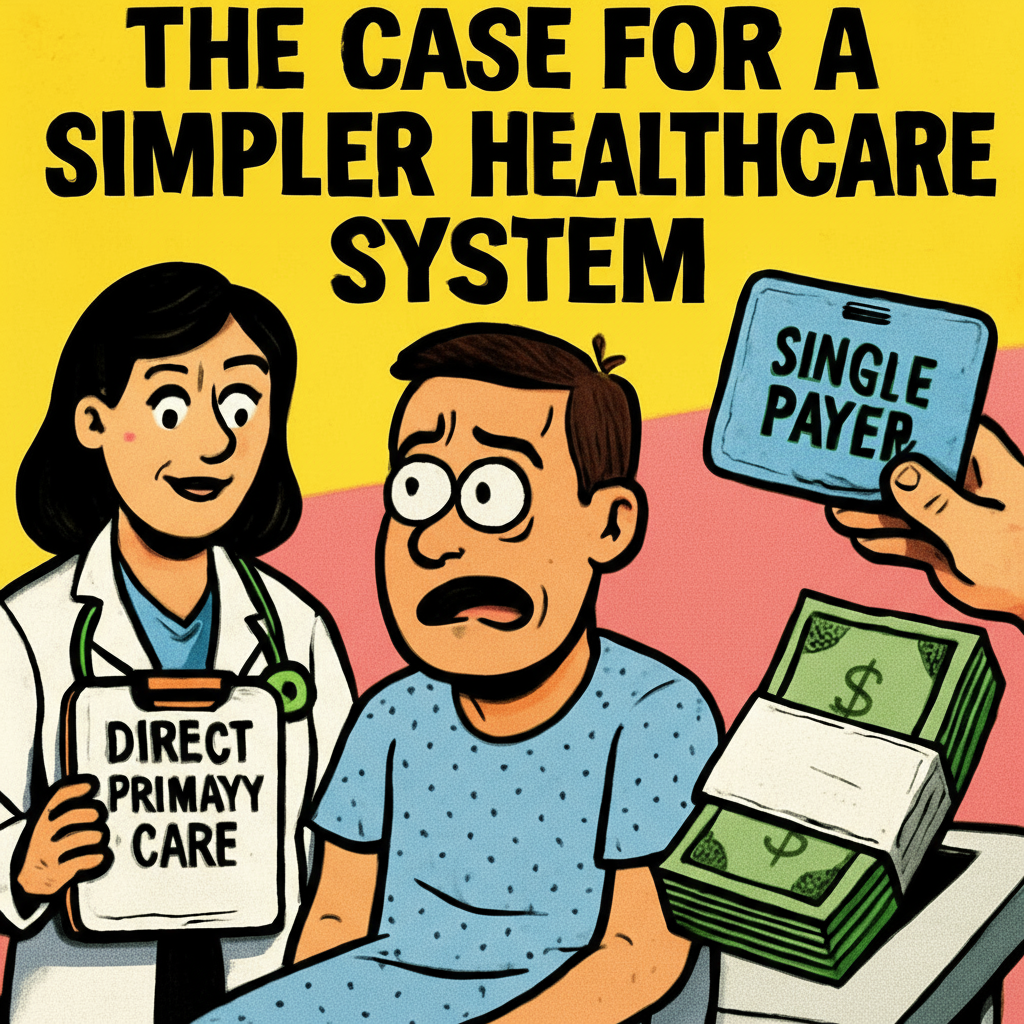
- Direct Primary Care (DPC) – Patients pay a flat monthly fee for unlimited primary care access.
- Single-Payer Systems – While not without flaws, these systems reduce administrative overhead by eliminating multi-payer complexity.
- Bundled Payments – A single payment for an entire episode of care, incentivizing efficiency without nickel-and-diming every step.
The Resistance to Simplicity
It’s important to acknowledge that complexity isn’t just accidental—it benefits certain stakeholders:
- Insurers use complexity to control payouts.
- Middleman Vendors thrive on providing navigation and compliance services.
- Some Providers leverage complexity to maximize reimbursement through aggressive coding.
Any simplification effort will face pushback from those whose business models depend on the current system.
Why Simplicity Matters Now
The U.S. spends more per capita on healthcare than any other developed nation—and yet our outcomes often lag behind. This issue arises from two main factors: inconsistencies in international data collection (e.g., unreported data in many countries, such as infant mortality for children delivered before 36-40 weeks not being counted as neonatal deaths) and our own internal difficulties.
That said, we can’t blame the science or the technology either; we must look at the structure.
Simplifying the system could:
- Reduce costs without reducing quality
- Improve access by cutting delays and administrative bottlenecks
- Restore the provider-patient relationship as the center of care
Final Thoughts: Complexity Is a Choice
Healthcare doesn’t have to be this complicated. We’ve chosen to accept a maze when we could build a map.
The first step toward simplicity is recognizing that complexity is not synonymous with safety or quality. It’s often just a barrier—one we have the tools to remove.
About the Author
Douglas J. Jorgensen, DO, CPC, FAAO, FACOFP
Dr. Doug is a physician, consultant, and national educator on healthcare policy and regulatory compliance. He helps organizations streamline processes, reduce waste, and focus on what matters most—caring for patients.